
A whole molecule with several research roles.
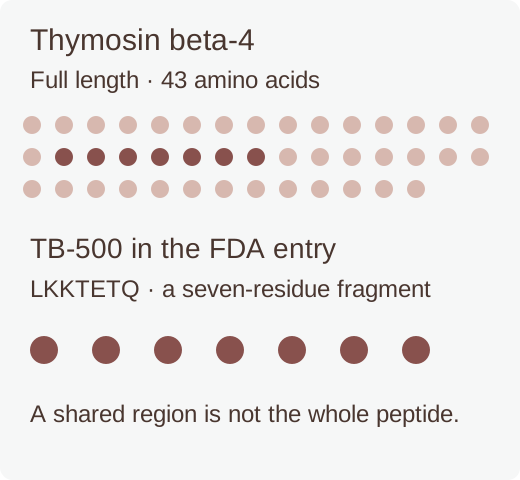
Thymosin beta-4, often written Tβ4 or TB4, is a naturally occurring 43-amino-acid peptide. Its best-known function is binding individual actin units, helping regulate their availability for the filaments that support cell shape and movement.
Researchers also investigate nuclear localisation and gene regulation. These mechanisms are not fully settled and can depend on the cell and injury setting. The earlier actin and basic-biology records are retained as PubMed record 16099219 and PubMed record 12581423.
Keep full length separate from TB-500.
The name TB-500 is used inconsistently outside formal source records. FDA’s relevant entry identifies a fragment, LKKTETQ. Full-length thymosin beta-4 and a short fragment are different materials.
That distinction is especially important when interpreting topical wound studies and animal cardiac research. A result with the complete sequence cannot be used as proof for another material described by a related trade or informal name. Our TB-500 page examines the identity problem directly.
Movement is part of repair.
Keratinocytes move over a wound surface. Fibroblasts move into a temporary framework and lay down matrix. Endothelial cells help form blood vessels. Actin dynamics participate in all these movements.
Thymosin beta-4 research examines migration, angiogenesis and inflammatory signalling, with proposed effects on cell survival and progenitor-cell behaviour. “Progenitor” describes a cell with the capacity to develop into a more specialised type. Such findings do not by themselves demonstrate restoration of functional tissue in humans.
Human wound work is route-specific.
The bibliography includes a wound-repair study in diabetic and aged mice: PubMed record 12581423. Useful endpoints include complete closure, time to closure, recurrence, discomfort and adverse events—not only a change in an intermediate marker.
A result in a chronic ulcer study cannot establish a general cosmetic benefit or the safety of systemic administration. Wound type, background care, formulation and trial design all influence interpretation.
Cardiac, musculoskeletal and neural research.
Cardiovascular work examines protection after experimental ischaemia, when blood supply is reduced. Cell survival, vascular changes and later remodelling are distinct endpoints. Preclinical findings are not evidence that the peptide regenerates a damaged human heart.
Muscle, tendon and ligament work examines inflammation, cellular recruitment and matrix organisation. Healing tissue can look improved without recovering normal mechanical properties, so functional testing matters.
Neurological work considers injury models, inflammatory responses and recovery measures. Blood-brain-barrier exposure, timing and species differences require specific evidence.
The earlier source links for these fields remain in the reading list. Their study populations and materials need to stay attached to each claim.
Safety cannot be inferred from an endogenous role.
Human safety depends on the preparation, route, exposure and population. A tolerability result in an early study does not resolve rare harms, chronic use, pregnancy, childhood, malignancy-related questions or interactions with other growth-related interventions.
Assay identity, impurities and manufacturing quality are separate from the compound’s biological promise. Data from a full-length preparation do not transfer to a fragment or an uncharacterised blend.
Delivery and engineered variants remain research questions.
Modified sequences, carriers, sustained-release materials and combinations with cells or scaffolds aim to change stability, targeting or repair behaviour. Each creates a new evaluation problem. Mechanistic complementarity alone cannot establish clinical synergy.
An experimental repair result does not establish a personal-use regimen.
Sources & further reading
- PubMed record 16099219
- PubMed record 12581423
- PubMed record 15565145
- PubMed record 17108969
- PubMed record 17254567
- PubMed record 16410788
- PubMed record 18427126
- PubMed record 20627173
- PubMed record 10469335
- PubMed record 20536467
- PubMed record 18616941
- PubMed record 17072343
Bibliography
- 1. Goldstein AL, Hannappel E, Kleinman HK. Thymosin beta4: actin-sequestering protein moonlights to repair injured tissues. Trends Mol Med. 2005;11(9):421-429. PMID: 16099219
- 2. Philp D, Badamchian M, Scheremeta B, et al. Thymosin beta 4 and a synthetic peptide containing its actin-binding domain promote dermal wound repair in db/db diabetic mice and in aged mice. Wound Repair Regen. 2003;11(1):19-24. PMID: 12581423
- 3. Bock-Marquette I, Saxena A, White MD, Dimaio JM, Srivastava D. Thymosin beta4 activates integrin-linked kinase and promotes cardiac cell migration, survival and cardiac repair. Nature. 2004;432(7016):466-472. PMID: 15565145
- 4. Smart N, Risebro CA, Melville AA, et al. Thymosin beta4 induces adult epicardial progenitor mobilization and neovascularization. Nature. 2007;445(7124):177-182. PMID: 17108969
- 5. Sosne G, Qiu P, Christopherson PL, Wheater MK. Thymosin beta 4 suppression of corneal NFkappaB: a potential anti-inflammatory pathway. Exp Eye Res. 2007;84(4):663-669. PMID: 17254567
- 6. Philp D, Scheremeta B, Sibliss K, et al. Thymosin beta4 promotes matrix remodeling during wound repair by attracting cells to sites of damage. J Invest Dermatol. 2006;126(3):602-610. PMID: 16410788
- 7. Hinkel R, El-Aouni C, Olson T, et al. Thymosin beta4 is an essential paracrine factor of embryonic endothelial progenitor cell-mediated cardioprotection. Circulation. 2008;117(17):2232-2240. PMID: 18427126
- 8. Morris DC, Chopp M, Zhang L, Lu M, Zhang ZG. Thymosin beta4 improves functional neurological outcome in a rat model of embolic stroke. Neuroscience. 2010;169(2):674-682. PMID: 20627173
- 9. Malinda KM, Sidhu GS, Mani H, et al. Thymosin beta4 accelerates wound healing. J Invest Dermatol. 1999;113(3):364-368. PMID: 10469335
- 10. Crockford D, Turjman N, Allan C, Angel J. Thymosin beta4: structure, function, and biological properties supporting current and future clinical applications. Ann N Y Acad Sci. 2010;1194:179-189. PMID: 20536467
- 11. Reti R, Kwon E, Nunes SS, Jankowski H, Okawa ER, Rahmani M. Thymosin beta-4 is cytoprotective in human glioma cells and enhances connexin 43 expression. Exp Cell Res. 2008;314(14):2518-2528. PMID: 18616941
- 12. Huang HC, Hu CH, Tang MC, Wang WS, Chen PM, Su Y. Thymosin beta4 triggers an epithelial-mesenchymal transition in colorectal carcinoma by upregulating integrin-linked kinase. Oncogene. 2007;26(19):2781-2790. PMID: 17072343