The identity needs to come before the mechanism.
Full-length thymosin beta-4 contains 43 amino acids. FDA identifies TB-500 as the LKKTETQ fragment associated with that molecule. Commercial and informal names have been used inconsistently, so a paper’s actual test material matters more than a shorthand label.
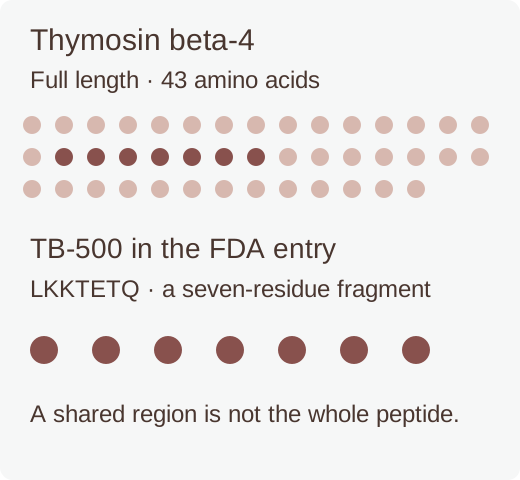
Wound, cardiac and neurological findings need the full peptide sequence and experimental model attached. A result for full-length thymosin beta-4 cannot establish the same activity or safety for a fragment.
Why actin appears throughout the literature.
Actin is a protein that forms part of a cell’s internal framework. It can exist as individual units, G-actin, or assembled filaments, F-actin. Changing that balance affects cell shape and movement.
Full-length thymosin beta-4 binds actin and is studied in cell migration and repair. Fibroblasts, keratinocytes and vessel-lining cells need coordinated movement during healing. A fragment’s inclusion of a related region is not proof that it reproduces the full molecule’s behaviour.
The earlier actin and migration reading trail is retained as PubMed record 22074294 and PubMed record 23050815. Each source needs to be read for its actual peptide and model.
Matrix assembly is an outcome to test.
The older account discussed collagen, fibronectin, proteoglycans and matrix hydration. Fibronectin helps form a temporary repair framework. Fibroblast movement and mechanical tension help organise what is deposited.
It also discussed TGF-beta signalling, myofibroblasts and MMP regulation in fibrosis. A myofibroblast is a contractile cell involved in wound closure and scar formation. These topics help frame repair research, but their mention is not evidence that TB-500 reduces scarring in people.
Vascular findings need the right molecule attached.
Thymosin beta-4 research explores VEGF-related signalling, endothelial cells, vascular maturation and tissue protection in experimental injury. Cardiac studies also examine survival of stressed cells, changes in remodelling and progenitor-cell responses.
The earlier cardiac and vascular references remain below, including PubMed record 20691219 and PubMed record 23749167. They are not presented here as clinical proof for a marketed TB-500 fragment.
Wounds, muscle and nerves are separate fields.
| Topic | Key distinction |
|---|---|
| Chronic skin wounds | Full-length topical formulations and human wound studies cannot validate an injectable fragment. |
| Tendon, ligament and muscle | Experimental healing and mechanical tests need human confirmation. |
| Cardiac injury | Animal protection or remodelling is different from clinical regeneration. |
| Stroke and peripheral nerves | Exploratory neural findings need identity-specific replication. |
| Scaffolds and combination research | Material, co-interventions and release conditions affect attribution. |
The reading list includes journal records and two general web pages. A general web page does not carry the same evidentiary weight as a primary study.
The regulatory entry is specific.
FDA’s page with content current as of April 22, 2026 lists thymosin beta-4 fragment LKKTETQ, also known as TB-500, as nominated but withdrawn. That status is not clearance or approval for compounding, and FDA’s safety concerns remain alongside the entry.
Evidence from the full-length peptide cannot establish fragment-specific immunogenicity, contaminants, human pharmacokinetics or long-term safety. Growth-related and angiogenic mechanisms also create questions that require direct safety investigation.
The full-length thymosin beta-4 profile keeps that research strand distinct. No loading phase, maintenance schedule or combination regimen is supported by this page.
Sources & further reading
- PubMed record 22074294
- PubMed record 23050815
- PubMed record 27450738
- Earlier general-web source: cellular migration and angiogenesis
- PubMed record 20691219
- PubMed record 29956769
- PubMed record 23749167
- Earlier general-web source: thymosin-related peptides
- PubMed record 27450737
- Full-text record PMC3411836
- PubMed record 17108969